home / my go-to frameworks
OPERATING FRAMEWORKS
My Go-To Frameworks
Two frameworks that go with me everywhere, no matter what's actually being done. One assigns ownership; the other maps the sequence.
Two All-Purpose Frameworks
GTM & RESEPONSIBILITIES MATRIX FRAMEWORKS
01
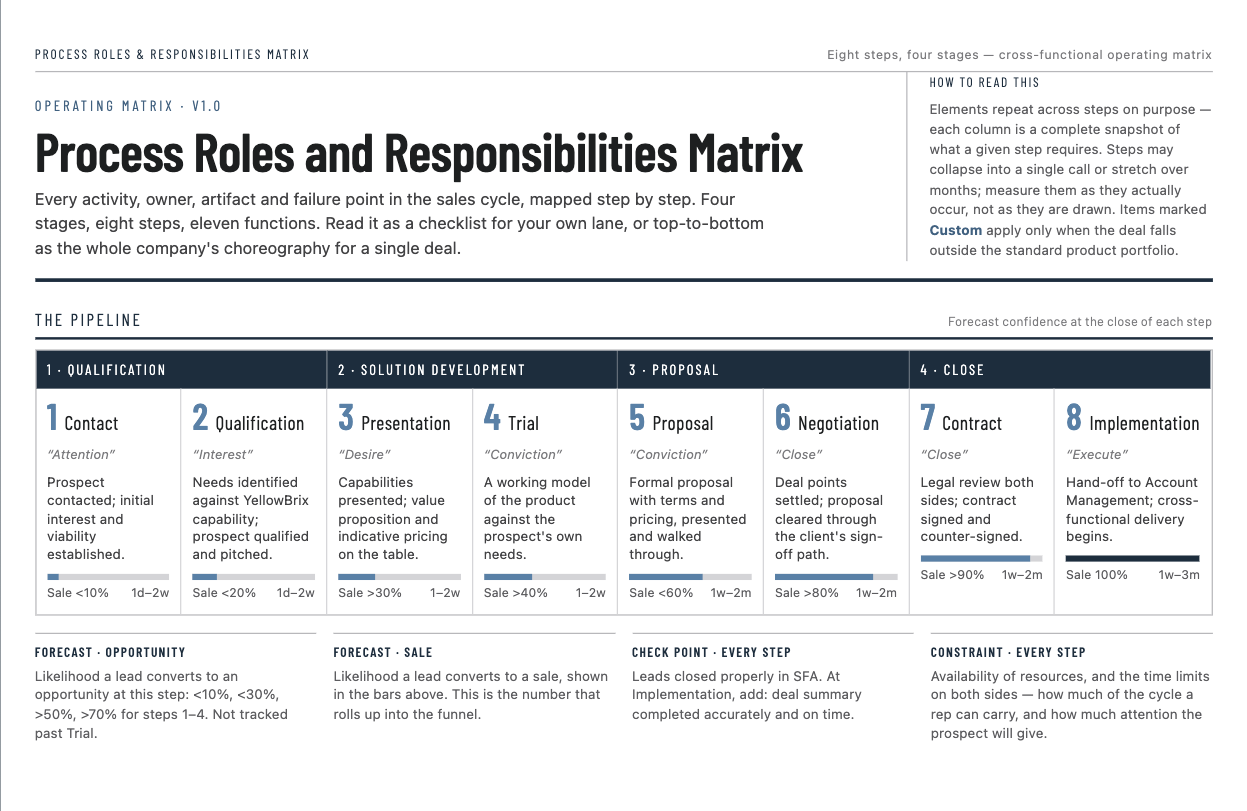
Roles and Responsibilities Matrix
Two Successful Frameworks Developed Over Time
Most of what you see here comes from one consistent approach: cross-functional process architecture applied to marketing, sales, and go-to-market execution—whether managing a product launch, a rebrand, a new market entry, or campaign operations.
A repeatable, scalable core framework has long been a hallmark of my work. These two frameworks matter most: the All-Purpose GTM Framework and the Process Responsibilities Matrix
02
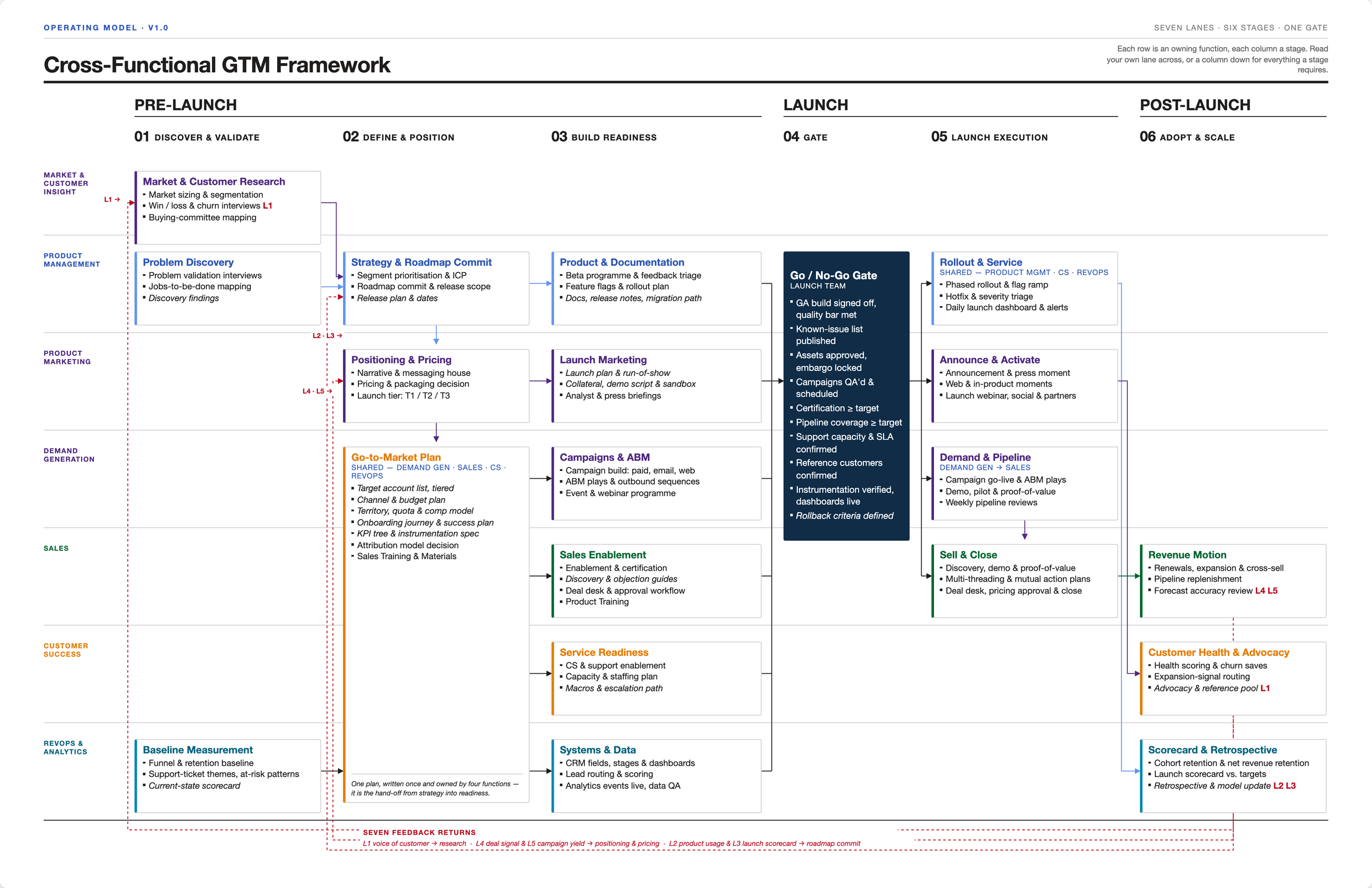
All-Purpose GTM Framework
Why these models?
When process is engineered correctly:
Accountability becomes systemic — It replaces subjective management with objective performance agreements, mapping out the exact "Who, What, Where, When, and How" of every departmental handoff.
Departments align almost automatically — By integrating support functions (Legal, Finance, and Implementation) directly into the revenue process, you establish a self-disciplined environment focused on shared objectives.
01
Roles & Responsibilities Matrix
GO-TO-MARKET DISCIPLINE THROUGH BPM OPTIMIZATION AND CROSS-FUNCTIONAL COORDINATION

*click to open original document
Open This Example and Check Out the Details in This Workflow
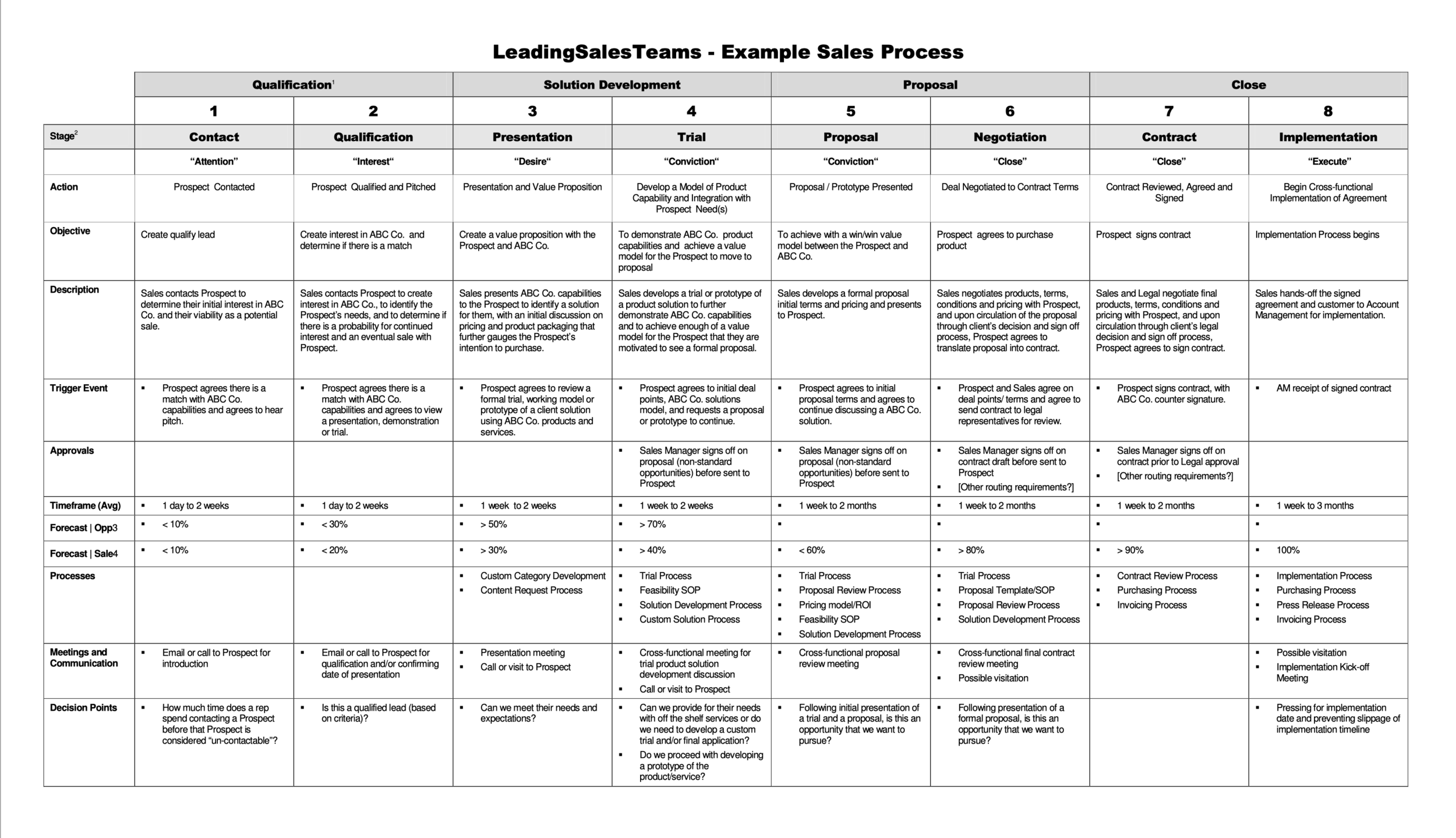
The Roles and Responsibilities Matrix is the strategic blueprint of a cross-functional workflow. Instead of listing isolated departmental tasks, the matrix maps the complete revenue lifecycle, showing exactly who does what, when, where, why, and how at every major handoff and transition stage. This level of detail is what makes it work so well.
It acts as a shared, highly detailed "game plan" that coordinates diverse teams (like Sales, Marketing, Legal, and Implementation) into a single synchronized unit.
Three Reasons Why I Like It
It Elevates the Objective Above the Individual
Standard company operations are often plagued by office politics, ego, and departmental silos. The model removes the personal friction by focusing entirely on the process. It positions roles and deliverables as objective, standard business requirements, creating a culture where people focus on fixing process breakdowns rather than pointing fingers at individuals.
It Maps the "Whitespace"
Revenue is rarely lost within a single department; it is lost in the unmanaged gaps where a qualified marketing lead gets ignored, or a signed sales contract fails to transition cleanly to the customer support and implementation teams. The matrix identifies and closes these gaps by defining the exact trigger events required to advance a deal to the next stage.
It Builds "Esprit de Corps" Organically
Esprit de corps cannot be manufactured through artificial team-building exercises. It is built when back-office teams (like Legal, Finance, and Customer Support) see their direct impact on the revenue cycle. The matrix proves that "everyone is in sales" by showing people that their speed in reviewing proposals, for example, reduces sales cycle time and creates opportunities to close more sales by the end of the quarter or fiscal year. Cross-functional staff can see how their input supports revenue goals.
*click to open original document
02
All-Purpose GTM Model
GO-TO-MARKET DISCIPLINE THROUGH BPM OPTIMIZATION AND CROSS-FUNCTIONAL COORDINATION

*click to open original document
Context
The GTM Launch Framework is one system for bringing any initiative to market: a new product, a rebrand, a new market, a major campaign, whatever. Instead of treating a launch as Marketing's job or Sales's job, it organizes the whole company around one synchronized rollout.
Three Reasons Why I Like It
It’s Applicable Beyond "Products and Services"
This model is adaptable. It works for a major brand repositioning, a new campaign rollout, a channel partnership program, or a flagship product launch. It ensures that whenever the organization brings anything to market, every customer-facing and operational department is prepared to support it.
It’s a Visual Reminder That Execution is a 360-Degree Cross-Functional View
Most launch failures don't happen because the campaign creative is bad or the product is broken; they happen because teams forget back-office and support dependencies. This framework provides a complete view of every functional area that must move in unison: Marketing, Sales, Product, Legal, Finance, Customer Support, Implementation, or other areas that may be involved.
It Transforms Launches into a Repeatable Process
Without a standardized framework, every new launch feels like reinventing the wheel, leading to missed deliverables and misallocated budgets. By turning GTM activity into a repeatable, metrics-driven process, the organization moves from reactive to predictable and can execute more reliably.
*NOTE
Refreshing Original Work Using AI Tools…
Sharing my original documents, created before AI made things a little easier, for anyone interested in the depth of detail in the Roles and Responsibilities Matrix or who prefers the visual flow of the All-Purpose GTM Framework.
01
Roles and Responsibilities Matrix
02
All-Purpose GTM Framework
